Skip navigation
3D Printing in Medicine – Titanium Implants, Medical Devices & Instruments 

/

/

3D Printing in Medicine –
Titanium Implants, Medical Devices & Instruments

3D printing in medicine is transforming healthcare by enabling patient-specific solutions. Using metal additive manufacturing technologies like Selective Laser Melting (SLM), healthcare providers can produce high-precision, durable components efficiently and reliably, improving treatment outcomes, precision, and surgical efficiency.

Experience the future of healthcare with 2onelab’s metal 3D printing solutions.

Key Points in Brief:

  • What it is: 3D printing in medicine via metal 3D printing enables patient-specific implants, medical devices, and surgical instruments tailored to each patient.
  • How it works & Materials:Technologies like SLM produce precise, complex components; titanium is ideal for implants and instruments, while stainless steel can be used for surgical tools.
  • Benefits: Improved outcomes, shorter surgery times, precise anatomical fit, and efficient production.
  • Product highlights: 2onelab 3D printers, including 2Create and 2Create Plus, offer maximum precision, flexibility, and reliability.,

Titanium Implants via 3D Printing

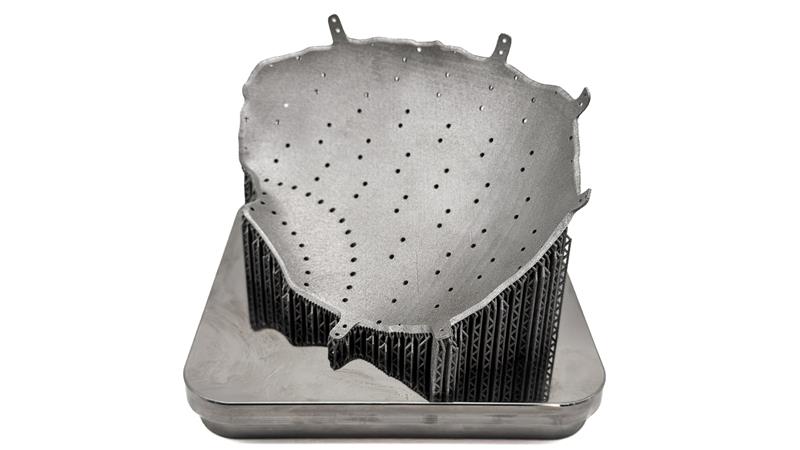
Titanium implants are biocompatible, lightweight, corrosion-resistant, and extremely strong, , making them ideal for orthopedic, craniofacial, and spinal applications. Using SLM and patient imaging data (CT/MRI), implants can be produced with with exact anatomical accuracy for jaw, skull, spine, and joint replacements.


3D-printed titanium jaw implant (Titanium), using 2Create metal 3D printer (SLM).

Benefits for Patients

  • Perfect anatomical fit
  • Faster recovery, fewer complications
  • Shorter surgery times

Titanium Implant Components

Metal 3D printing also enables the production of individual implant components, including:

  • Joint balls for hip or shoulder joints
  • Screws, plates, and connectors
  • Prosthesis adapters with complex geometries

Optimized Implant Surfaces

  • Porous lattice structures: Fine, mesh-like structures in the implant allow bone cells to grow in, improving fixation within the bone.
  • Surface treatment: Specialized surface textures increase the implant’s durability and stability.

Titanium Medical Devices

3D printing in medicine also offers major benefits for medical devices. A leading example is 3D-printed titanium hearing aids, manufactured using the 2Create metal 3D printer.

Watch the complete manufacturing process of 3D-printed titanium hearing aids.

Benefits for Patients and Manufacturers

  • Titanium: lightweight, durable, biocompatible
  • Complex, intricate shapes possible
  • Maximum fit and comfort
  • Faster production, minimal post-processing, precise mechanics

Experimental applications include cochlear implant housings and infusion pump components, showing the growing potential of medical 3D printing with SLM.

Patient-Specific Surgical Instruments

For surgeries, specialized instruments can be 3D-printed from titanium or stainless steel to fit individual patients.

Examples include:

  • Patient-specific drill guides for dental and orthopedic surgery
  • Alignment and positioning templates
  • Endoscopy and microsurgery instruments with fine, complex structures


These instruments provide precise guidance, enhance safety, and are often used as single-use applications.

The Future of 3D Printing in Medicine & Healthcare

3D printing in medicine and healthcare enables efficient, precise, and patient-specific production of implants, medical devices, surgical instruments, and prosthetics —including dental prosthetics like crowns, bridges, and aligners.

Metals like titanium are ideal for high-strength implants, while polymers and biocompatible plastics create lightweight, flexible solutions such as orthopedic braces, dental aligners, or hearing aid shells.

Additive manufacturing also enables bioprinting, layering living cells into tissue-like structures for research and regenerative medicine. Adoption is growing, but it is still emerging and not standard practice.

Conclusion – 3D Printing in Medicine with 2onelab

Advanced medical 3D printers from 2onelab, including 2Create and 2Create Plus, enable the efficient and reliable production of patient-specific implants, surgical instruments, and medical devices using Selective Laser Melting (SLM).

With 2onelab, healthcare providers can achieve high-precision, durable components, improve patient outcomes, reduce surgery times, and streamline surgical workflows.

3D Printers for Dentistry 2Create and 2Create Plus

Advanced Medical 3D Printers


Choose 2onelab – with the 2Create and 2Create Plus metal 3D printers for dental, medical, industrial, and R&D use.

Enhance precision, reduce waste, and work smarter – with state-of-the-art technology and hands-on expertise.

Metal 3D Printers

Contact us for more information!

FAQ: 3D Printing in Medicine

It is used to manufacture patient-specific implants, prosthetics (including dental prosthetics), surgical instruments, and medical devices. Additive manufacturing technologies such as powder bed fusion (PBF), including metal SLM and polymer SLS, enable complex geometries, precise structures, and full customization for individual patients.

– Perfect anatomical fit for each patient

– Faster recovery and fewer complications

– Lightweight, strong, and biocompatible

– Shorter surgery times

Joint balls, screws, plates, and prosthesis adapters – including complex geometries and customized designs.

– Porous lattice structures promote bone cell integration

– Optimized surfaces enhance durability and strength

Yes. They are lightweight, robust, biocompatible, and individually customizable, offering patients comfort and longevity. Manufacturers benefit from faster production and minimal post-processing.

Drill guides, alignment templates, and micro-instruments can be printed patient-specifically from titanium or stainless steel, improving precision and safety. These are often used as single-use instruments.

2onelab provides advanced medical 3D printers, including 2Create and 2Create Plus, optimized for metal additive manufacturing with SLM. These systems allow healthcare providers to produce high-precision, patient-specific titanium implants, surgical instruments, and medical devices—for example, titanium hearing aids—enhancing customization, efficiency, and treatment outcomes.

Further links:

Author picture

Author: Markus Wolf

Passionate about 3D printing, while being
CTO and Co-Founder of 2onelab.

Share blog post

contact

cta contact icon lime

Reach Out Now

Let’s discuss how we can accelerate your 3D printing projects together. Contact us!